
THE SHAPE: Calibration-invariant morphology and identifiable geometric response
A precise image scale can coexist with an uncertain physical interpretation. THE SHAPE examines what remains identifiable when an astronomical measurement loses phase information, depends on telescope calibration, or is interpreted through a specified physical model.
Onur H. Evgin and Eolisa Space Science Team · Eolisa Space
Research release 9.0.0 · Research preprint

From measurement to interpretation
An interferometer samples the Fourier structure of sky brightness. Its measurements connect pairs of telescopes and contain both amplitude and phase. Recovering an image, fitting an emission model and assigning a physical meaning to a fitted scale are related tasks, each with its own assumptions.
THE SHAPE studies those assumptions explicitly. The work combines analytical derivations, unchanged public Event Horizon Telescope data and controlled numerical experiments. Four connected investigations follow the information from the measurement to the model: phase loss, station calibration, observed morphology and geometric response.
The information lost with phase
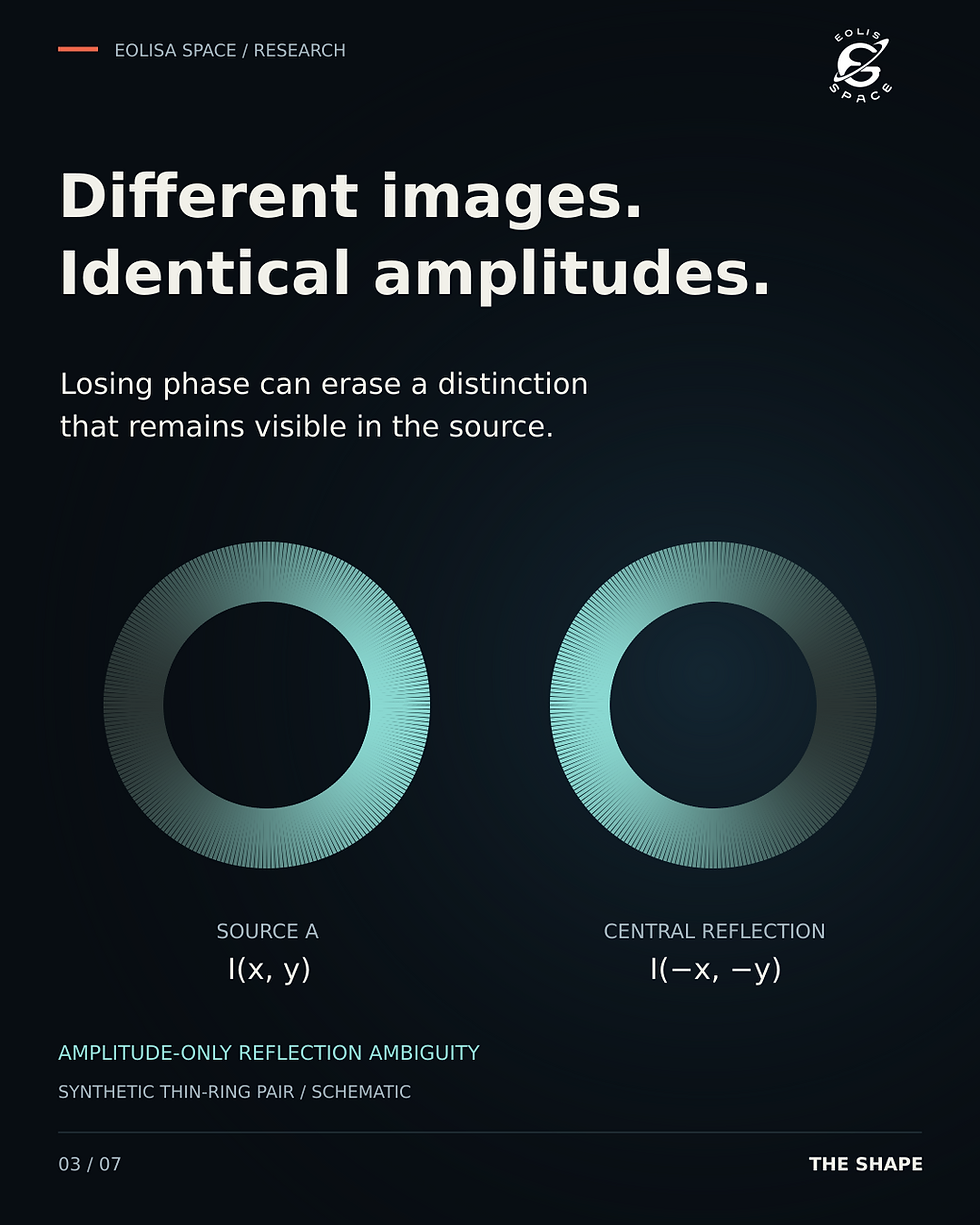
The first investigation considers a real, even brightness distribution with an odd perturbation. Such a construction isolates a specific symmetry question: how strongly can a small change be distinguished when only Fourier amplitudes are retained?
An exact Rice-noise calculation gives a quartic local relative-entropy response for amplitude data. Phase-referenced complex data respond quadratically. Under fixed nuisance parameters and independent repetitions, the corresponding local separation scales are N⁻¹/⁴ and N⁻¹/². These rates describe the stated mathematical experiment; they are not universal sensitivity forecasts for the EHT. Central reflection preserves every Fourier amplitude exactly, leaving that ambiguity unresolved regardless of amplitude precision.
What survives station calibration
Measured visibility amplitudes also depend on multiplicative gains at individual telescopes. THE SHAPE uses a noise-whitened array-graph projection to remove the corresponding nuisance directions. The construction identifies combinations of log amplitudes that survive the specified station-gain model and calculates local information for morphology parameters.
Cancellation is exact in the noiseless log-amplitude mean. The finite-noise analysis remains conditional on a high-SNR approximation, covariance weights and the selected measurements. Unsupported parameter directions are reported explicitly. Local information scales are not substituted for global observational confidence intervals.
The same observations, different assumptions

The public-data component examines 106,138 visibility records across twelve M87* and Sagittarius A* day/band files. The original CSV bytes match pinned upstream releases, and each source file is identified by a cryptographic digest. Day and frequency-band files remain separate throughout the analysis.
One comparison shows how strongly calibration assumptions affect the information budget. With baselines of at least 0.1 Gλ and measured amplitude SNR of at least five, the selected records contain 1,183 independent residual log-amplitude modes when station gains are independent at every timestamp. Gains held constant within observing blocks leave 39,622 modes; gains held constant within individual files leave 40,732.
These are ranks under alternative nuisance models on the same records. They do not measure actual gain-stability times. Independent gains at every timestamp form a deliberately permissive stress test, rather than a description of the EHT calibration procedure. Under that timestamp-level model and compact-baseline selection, increasing the measured-SNR threshold to ten leaves no residual modes in these twelve files. The result concerns the selected graph and assumptions, not the total information in EHT observations.
The observed audit also records parameter boundaries, unresolved alternatives and observing blocks held out from fitting. Supporting closure-phase diagnostics retain both amplitude-degenerate orientations. They are derived from the same underlying observations and serve as descriptive checks, rather than independent evidence selected to favor an orientation. This separation keeps each diagnostic connected to the question it can answer.
Equal critical size, different light bending

The geometric investigation is a separate calculation within the static Simpson–Visser family. Over the studied parameter range, the critical size can remain constant while returning light rays show different deflection at finite impact parameter.
A positive-moment representation provides deflection expansions, two-sided remainder bounds and conditional inverse enclosures. The recorded implementation evaluates 592 forward cases and 4,736 truncation checks, with 64 independent geodesic comparisons. These calculations test the specified model response. An inverse requires the metric family, mass, impact parameter and unwrapped deflection to be known; it does not identify a spacetime from the public visibility data.
A research record that can be inspected
The release brings together the article, proofs, public inputs, executable analyses, figures, tests and machine-readable results. Verification records include source hashes, dependency versions, numerical comparisons and the baseline suite of 214 passing tests. The reproduction workflow preserves the supplied results and writes a separate set of outputs for comparison.
The study attributes its foundations in Fourier symmetry, closure statistics, nuisance projection and gravitational lensing to the relevant literature. Its contribution is expressed through the particular derivations, implementations, controls and observed comparisons documented in the release.
THE SHAPE treats emission-ring fits as phenomenological morphology. It does not turn those fitted scales into a calibrated shadow diameter or an observational identification of spacetime geometry. The accompanying English documentary and official trailer explain the research through clearly labeled public data, synthetic controls and model calculations.

