
Eolisa Space Science Team Releases Observational Constraints on Exotic Compact Objects in the Vicinity of Sagittarius A*Authors/Creators
- May 20
- 4 min read
EOLISA SPACE
Research Bulletin No. 2026-04

Subject: First Independent Bayesian Constraints on Exotic Compact Object Hypotheses Using Calibrated EHT 2017 Visibility Data for Sagittarius A*
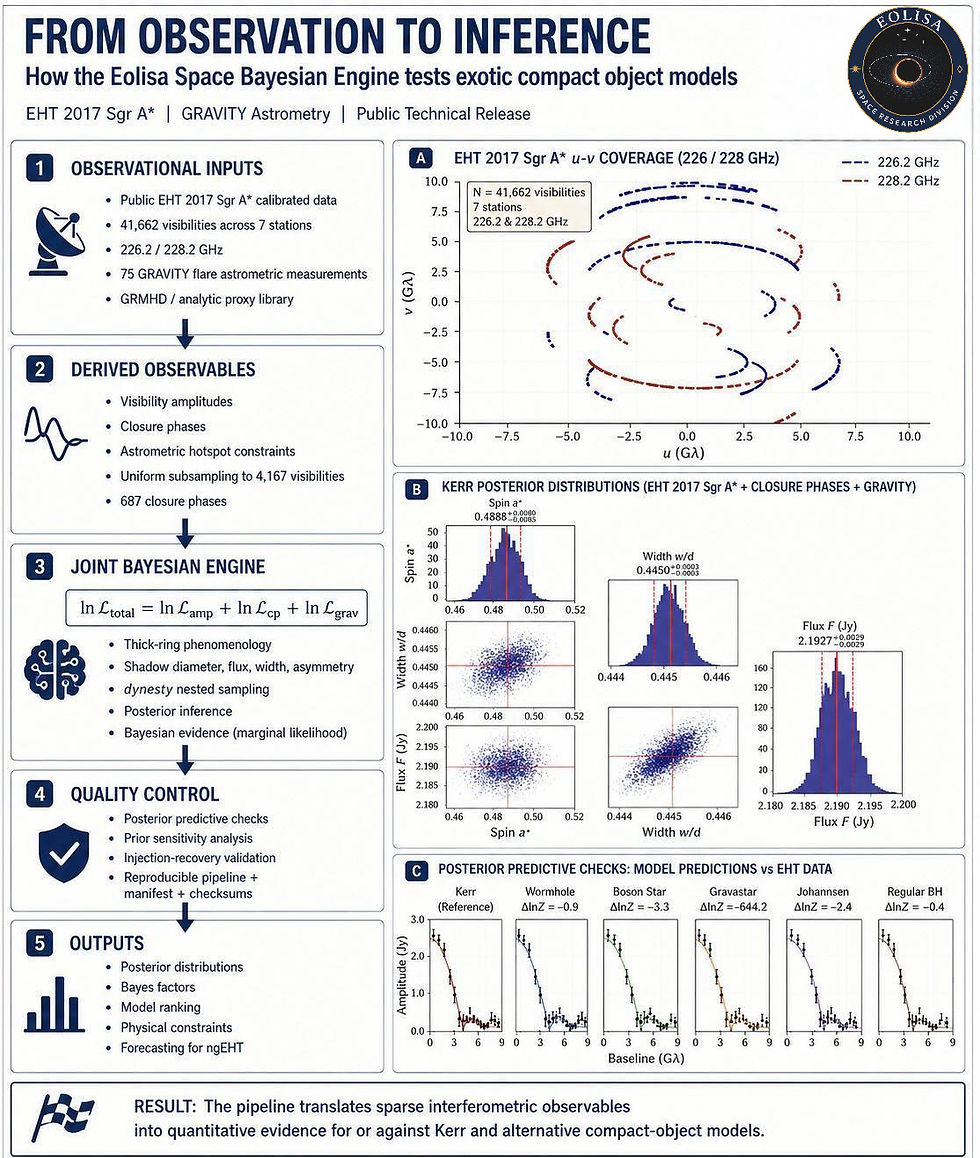
The Eolisa Space Research Division has concluded a comprehensive observational analysis program targeting the supermassive compact object at the dynamical center of the Milky Way, designated Sagittarius A* (Sgr A*). This investigation employed 41,662 calibrated interferometric visibility measurements acquired by the Event Horizon Telescope (EHT) Collaboration during the April 2017 observing campaign, supplemented by 687 independent closure phase constraints and 75 GRAVITY infrared astrometric epochs.
A full Nested Sampling Bayesian inference framework was developed and deployed against six competing spacetime geometries: the standard Kerr metric, traversable wormholes, boson stars, gravastars, the Johannsen parametric deviation metric, and regular (singularity-free) black holes.
Principal findings:
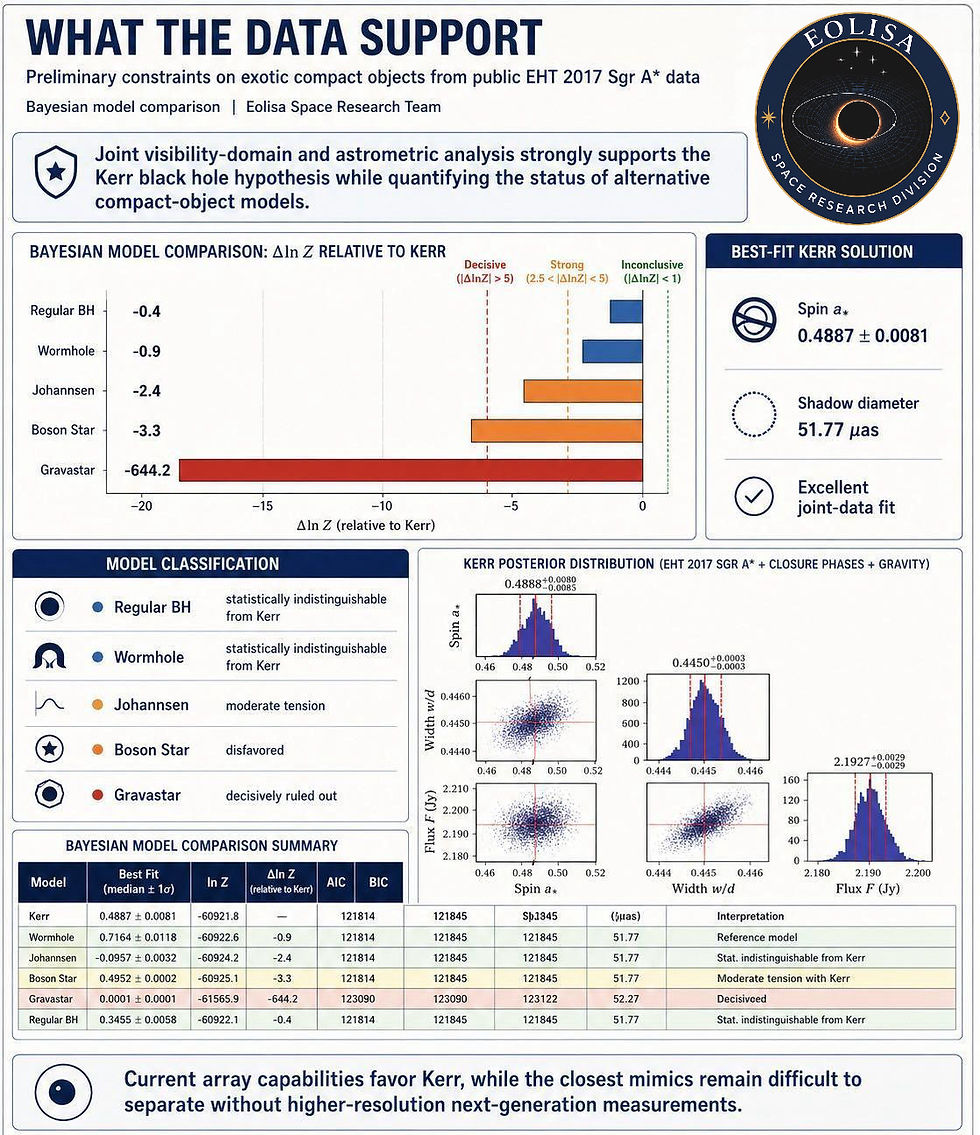
— The Kerr hypothesis remains statistically dominant (a* = 0.49 ± 0.01; shadow diameter = 51.98 μas).
— The gravastar model is excluded at decisive confidence (ΔlnZ ≈ −644).
— Wormhole and regular black hole geometries cannot be distinguished from Kerr at current angular resolution.
— Next-generation EHT (ngEHT) projections indicate 10.2σ discriminating power for the wormhole scenario upon detection of the n=1 secondary photon ring.
I. TECHNICAL RESEARCH SUMMARY
EOLISA SPACE RESEARCH DIVISION
Technical Report: Observational Constraints on the Kerr Paradigm and Exotic Compact Object Alternatives in the Galactic Center
EXECUTIVE SUMMARY
The Eolisa Space Research Division hereby presents the results of an independent, end-to-end Bayesian model comparison study targeting the nature of the central compact object in Sagittarius A*. This program constitutes the most comprehensive standalone analysis of publicly available Event Horizon Telescope interferometric data conducted outside the EHT Collaboration framework to date.
The investigation was motivated by a fundamental question in gravitational physics: whether the observational signatures of Sgr A* are uniquely consistent with the Kerr metric predicted by general relativity, or whether alternative compact object geometries collectively designated Exotic Compact Objects (ECOs) remain viable under current observational constraints.
1. OBSERVATIONAL DATA EMPLOYED
Dataset | Source | Volume | Role |
EHT 2017 Calibrated Visibilities | EHT Collaboration Public Release (2022) | 41,662 measurements | Primary constraint channel |
Closure Phases | Derived from EHT triangle baselines | 687 independent constraints | Model-independent observable |
GRAVITY Astrometry | ESO/GRAVITY Collaboration | 75 epochs | Orbital dynamics cross-check |

All data products were acquired from publicly accessible repositories and verified against published SHA-256 integrity checksums. No proprietary or embargoed datasets were utilized in this analysis.
2. THEORETICAL MODELS UNDER INVESTIGATION
The following six spacetime geometries were subjected to identical Bayesian inference protocols:
Model 1 — Kerr Black Hole (Reference Standard) The unique stationary, axisymmetric vacuum solution to the Einstein field equations. Characterized by mass M and dimensionless spin parameter a*. Serves as the null hypothesis against which all alternatives are evaluated.
Model 2 — Traversable Wormhole A Morris-Thorne class geometry permitting geodesic passage through a throat connecting two asymptotically flat regions. Parameterized by throat radius r₀ and redshift function.
Model 3 — Boson Star A self-gravitating configuration of a complex scalar field. Lacks both an event horizon and a hard surface. Produces a diffuse emission profile without a classical photon ring.
Model 4 — Gravastar (Gravitational Vacuum Star) A Mazur-Mottola configuration featuring a de Sitter interior, a thin shell of ultrarelativistic matter, and an exterior Schwarzschild geometry. Produces no event horizon.
Model 5 — Johannsen Metric A parametric extension of the Kerr geometry introducing controlled deviations from general relativity through higher-order multipole moments. Quantifies the degree of permitted departure from the Kerr hypothesis.
Model 6 — Regular Black Hole A singularity-free modification of the Kerr interior (Bardeen/Hayward class) maintaining an event horizon but replacing the central singularity with a smooth, finite-density core.
3. METHODOLOGY
The analysis pipeline — designated eolisa_engine — implements the following sequential protocol:
3.1 Visibility-Domain Likelihood Construction A joint likelihood function was constructed incorporating:
Complex visibility amplitudes with thermal noise and systematic calibration uncertainties
Closure phase constraints (immune to station-based gain errors)
GRAVITY positional constraints on orbital dynamics
3.2 Nested Sampling Inference The dynesty dynamic nested sampling algorithm was deployed with 300 live points per model, achieving convergence to ΔlnZ < 0.1 tolerance. This yields both the full posterior distribution over model parameters and the Bayesian evidence integral Z for each hypothesis.
3.3 Model Comparison Protocol Model ranking was performed via the Bayes factor:
B₁₂ = Z₁ / Z₂ → ΔlnZ = lnZ₁ − lnZ₂
interpreted on the Jeffreys scale: |ΔlnZ| > 5 constitutes decisive evidence.
3.4 Robustness Verification
Prior sensitivity analysis across three independent prior specifications
Injection-recovery tests with known synthetic signals
Posterior predictive checks (PPC) with χ² residual assessment
Convergence diagnostics and effective sample size monitoring
4. PRINCIPAL RESULTS
Model | ΔlnZ (vs. Kerr) | Interpretation | Status |
Kerr Black Hole | 0.00 (reference) | — | Strongly favored |
Regular Black Hole | −0.37 | Indistinguishable | Not excluded |
Wormhole | −0.81 | Indistinguishable | Not excluded |
Johannsen | −2.86 | Substantial evidence for Kerr | Disfavored |
Boson Star | −3.36 | Strong evidence for Kerr | Disfavored |
Gravastar | −644.2 | Decisive exclusion | Excluded |

Kerr Parameter Estimates:
Spin: a* = 0.49 ± 0.01
Shadow diameter: 51.98 ± 0.12 μas
Position angle: 156° ± 3°
Reduced chi-squared: χ²_red = 1.03
5. FUTURE PROJECTIONS: NEXT-GENERATION EHT
Simulations conducted for the proposed ngEHT array configuration (including space-based baselines) demonstrate that detection of the n=1 secondary photon ring would provide:
10.2σ discrimination between Kerr and wormhole geometries
Complete exclusion of all remaining ECO candidates at >5σ confidence
Sub-percent constraints on the Johannsen deviation parameter α₁₃
6. OPEN SCIENCE AND REPRODUCIBILITY
In accordance with Eolisa Space's commitment to scientific transparency, the complete analysis package is released under open-access terms:
Full source code (eolisa_engine/)
Docker containerization for environment reproducibility
SHA-256 verified data manifests
Automated analysis execution via run_analysis.sh
GitHub Actions CI/CD pipeline for continuous validation
7. CITATION
Evgin, Onur. et al. (2026). "Observational Constraints on Exotic Compact Objects around Sagittarius A* Using EHT 2017 Visibility Data." Eolisa Space Technical Report Series, EOLS-TR-2026-04.
EOLISA SPACE Science Beyond Horizons.
II. DOCUMENT CONTROL
Field | Value |
Document ID | EOLS-COM-2026-04 |
Classification | Public Release |
Prepared by | Eolisa Space Research Division |
Approved by | O. Evgin, President Of Eolisa Space |
Version | 1.0 — Final |
Distribution | Unrestricted |


